Utilidad y eficacia de los antiagregantes plaquetarios en COVID 19: Revisión crítica de la evidencia
Resumen
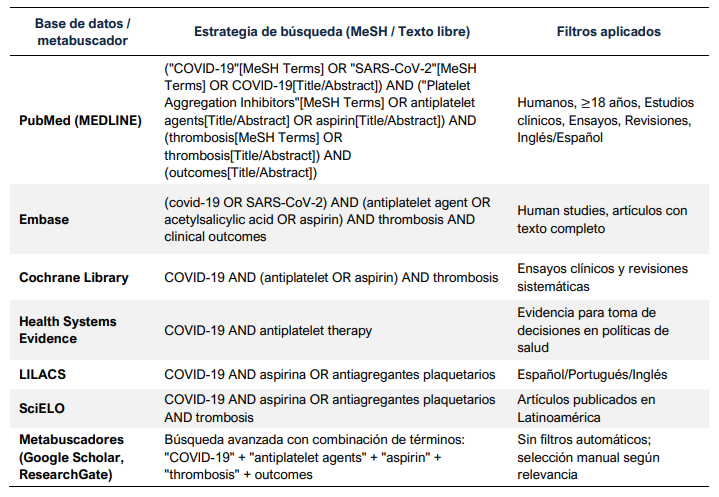
Objetivo: Revisar la evidencia científica disponible sobre la eficacia y seguridad de la terapia antiagregante plaquetaria en pacientes adultos con COVID-19 con especial énfasis en su impacto sobre la mortalidad y los eventos trombóticos. Material y métodos: Se realizó una revisión bibliográfica de estudios observacionales, ensayos clínicos y revisiones sistemáticas publicados entre los años 2020 y 2024, realizados en pacientes adultos que tuvieron diagnóstico de COVID 19 y que hayan sido atendidos tanto a nivel intrahospitalario como extrahospitalario. Se realizó la búsqueda en las bases de datos PubMed, Embase, Health Systems Evidence, Cochrane, LILACS y Scielo. Los artículos seleccionados fueron evaluados según criterios de calidad establecidos por la plantilla CASPE, y los niveles de evidencia y grados de recomendación de Joanna Briggs Institute (JBI). Resultados: De un total de 121 artículos, 40 fueron seleccionados para revisión a texto completo y finalmente 13 cumplieron los criterios de inclusión. Entre ellos se incluyeron 4 revisiones sistemáticas, 8 estudios de cohorte y 1 ECA. Los hallazgos muestran que el uso de antiagregantes plaquetarios, particularmente ácido acetilsalicílico, podría reducir ligeramente la incidencia de eventos trombóticos, aunque la evidencia sobre su efecto en la mortalidad es limitada y heterogénea. Los metaanálisis de ECA mostraron que la terapia antiplaquetaria reduce los eventos trombóticos mayores (RR 0,86–0,90), no modifica la mortalidad (RR 0,95–1,0) y aumenta el riesgo de hemorragia mayor (RR/OR 1,62–1,68). Estudios observacionales reportaron resultados variables en mortalidad, ingreso a UCI y necesidad de ventilación mecánica. Conclusiones: Los antiagregantes plaquetarios podrían ayudar a prevenir eventos trombóticos en COVID-19, especialmente si se administran temprano o en pacientes de alto riesgo. Su efecto sobre mortalidad y otros desenlaces es heterogéneo y no permite recomendaciones concluyentes. Se necesitan más ensayos aleatorizados multicéntricos para definir pacientes beneficiarios, dosis, inicio y duración óptimos.
Citas
Six I, Guillaume N, Jacob V, Mentaverri R, Kamel S, Boullier A, et al. The Endothelium and COVID-19: An Increasingly Clear Link Brief Title: Endotheliopathy in COVID-19. IJMS. 2022;23(11):6196.
Asimakos AT, Vassiliou AG, Keskinidou C, Spetsioti S, Antonoglou A, Vrettou CS, et al. Persistent Endothelial Lung Damage and Impaired Diffusion Capacity in Long COVID. JPM. 2023;13(9):1351.
Santoro L, Falsetti L, Zaccone V, Nesci A, Tosato M, Giupponi B, et al. Impaired Endothelial Function in Convalescent Phase of COVID-19: A 3 Month Follow Up Observational Prospective Study. JCM. 2022;11(7):1774.
Iba T, Wada H, Levy JH. Platelet Activation and Thrombosis in COVID-19. Semin Thromb Hemost. 2023;49(01):055-61.
Smęda M, Hosseinzadeh Maleki E, Pełesz A, Chłopicki S. Platelets in COVID-19 disease: friend, foe, or both? Pharmacol Rep. 2022;74(6):1182-97.
Bouchlarhem A, Boulouiz S, El Aidouni G, Bkiyar H, Bazid Z, Ismaili N, et al. The Impact of Prior Antithrombotic use on Thromboembolic Events in Patients with Cardiovascular Disease and Severe COVID-19 Infection. Clin Appl Thromb Hemost. 2022;28:107602962211414.
Páramo JA, Marcos-Jubilar M. Inmunotrombosis: un mecanismo clave en la pandemia por COVID-19. Medicina Clínica. 2024;S0025775324004032.
Abani O, Abbas A, Abbas F, Abbas M, Abbasi S, Abbass H, et al. Aspirin in patients admitted to hospital with COVID-19 (RECOVERY): a randomised, controlled, open-label, platform trial. The Lancet. 2022;399(10320):143-51.
Xue L, Qi Y, Zou Y. Short-term safety and efficacy of aspirin in patients with COVID-19: a systematic review and meta-analysis of randomized controlled trials. PeerJ. 2025;13:e19466.
Al Harthi AF, Aljuhani O, Korayem GB, Altebainawi AF, Alenezi RS, Al Harbi S, et al. Evaluation of Low-Dose Aspirin use among Critically Ill Patients with COVID-19: A Multicenter Propensity Score Matched Study. J Intensive Care Med. 2022;37(9):1238-49.
Aromataris E, Lockwood C, Porritt K, Pilla B, Jordan Z, editores. JBI Manual for Evidence Synthesis [Internet]. JBI; 2024 [citado 1 de noviembre de 2025]. Disponible en: https://jbi-global-wiki.refined.site/space/MANUAL
Conway EM, Mackman N, Warren RQ, Wolberg AS, Mosnier LO, Campbell RA, et al. Understanding COVID-19-associated coagulopathy. Nat Rev Immunol. 2022;22(10):639-49.
Eman A, Balaban O, Süner KÖ, Cırdı Y, Şahin F, Demir G, et al. The effect of low-dose and high-dose low-molecular-weight-heparin and aspirin thromboprophylaxis on clinical outcome and mortality in critical ill patients with COVID-19: A retrospective cohort study. SMJ. 2022;43(7):715-22.
Pan D, Ip A, Zhan S, Wasserman I, Snyder DJ, Agathis AZ, et al. Pre-hospital antiplatelet medication use on COVID-19 disease severity. Heart & Lung. 2021;50(5):618-21.
Sahai A, Bhandari R, Godwin M, McIntyre T, Chung MK, Iskandar JP, et al. Effect of aspirin on short-term outcomes in hospitalized patients with COVID-19. Vasc Med. 2021;26(6):626-32.
Dalbeni A, Susca N, Daidone M, Rossi I, Giontella A, Cimellaro A, et al. Low dose aspirin and clinical outcomes in patients with SARS-CoV-2 pneumonia: a propensity score-matched cohort analysis from the National SIMI‑COVID‑19 Registry. Intern Emerg Med. 2023;18(8):2311-9.
Vinod P, Krishnappa V, Rathell W, Amir S, Sundil S, Dogbey G, et al. Effect of Aspirin Use on the Adverse Outcomes in Patients Hospitalized for COVID-19. Cardiol Res. 2024;15(3):179-88.
Wijaya I, Andhika R, Huang I, Purwiga A, Budiman KY. The effects of aspirin on the outcome of COVID-19: A systematic review and meta-analysis. Clinical Epidemiology and Global Health. 2021;12:100883.
Chow JH, Rahnavard A, Gomberg-Maitland M, Chatterjee R, Patodi P, Yamane DP, et al. Association of Early Aspirin Use With In-Hospital Mortality in Patients With Moderate COVID-19. JAMA Netw Open. 2022;5(3):e223890.
Chow JH, Yin Y, Yamane DP, Davison D, Keneally RJ, Hawkins K, et al. Association of prehospital antiplatelet therapy with survival in patients hospitalized with COVID‐19: A propensity score‐matched analysis. Journal of Thrombosis and Haemostasis. 2021;19(11):2814-24.
Kao G, Chen Y, Fan J. Efficacy and safety of antiplatelet therapy in COVID-19: Insights from a meta-analysis of randomized controlled trials. Int Journal of Clinical Pharmacology and Therapeutics. 2024;62(05):195-203.
Fischer AL, Messer S, Riera R, Martimbianco ALC, Stegemann M, Estcourt LJ, et al. Antiplatelet agents for the treatment of adults with COVID-19. Cochrane Haematology Group, editor. Cochrane Database of Systematic Reviews [Internet]. 2023 [citado 15 de septiembre de 2024];2023(7). Disponible en: http://doi.wiley.com/10.1002/14651858.CD015078
Abdi M, Lamardi ZH, Shirjan F, Mohammadi L, Abadi SSD, Massoudi N, et al. The Effect of Aspirin on the Prevention of Pro-thrombotic States in HospitalizedCOVID-19 Patients: Systematic Review. CHAMC. 2022;20(3):189-96.
Matli K, Chamoun N, Fares A, Zibara V, Al-Osta S, Nasrallah R, et al. Combined anticoagulant and antiplatelet therapy is associated with an improved outcome in hospitalised patients with COVID-19: a propensity matched cohort study. Open Heart. 2021;8(2):e001785.
Connors JM, Brooks MM, Sciurba FC, Krishnan JA, Bledsoe JR, Kindzelski A, et al. Effect of Antithrombotic Therapy on Clinical Outcomes in Outpatients With Clinically Stable Symptomatic COVID-19: The ACTIV-4B Randomized Clinical Trial. JAMA. 2021;326(17):1703.